
How Baby Name Popularity Works
Published October 10, 2026 · Based on U.S. Social Security Administration data
When you see that a name is "#12" or "peaked in 1990," where does that come from? This guide walks through how the numbers are counted, how names get ranked, why a name's rank can change even when nothing about the name has changed, and how to read the little trend chart on Seek Baby Names. No math degree required.
Where the numbers come from
Everything on Seek Baby Names comes from the U.S. Social Security Administration (SSA), which publishes how many babies were given each first name every year, going all the way back to 1880. The counts come from Social Security card applications, so they reflect babies born in the United States who were given a Social Security number.
A few things are good to know up front:
- Girls and boys are counted separately. The same name can show up on both lists, and each list has its own rank.
- Every spelling is its own name. Sophia and Sofia are counted separately, and so are Ethan and Ethen.
- Very rare names are left out. The SSA only publishes a name for a given year and sex if at least 5 babies had it. This protects privacy, and it means very unusual names don't appear.
- Older years are less complete. In the early years of the data, far fewer people had Social Security numbers, so the older counts are best read as a general picture rather than an exact headcount.
How names get ranked
Ranking is simple. For each year, the names are lined up from the most babies to the fewest, separately for girls and boys. The name at the front is #1, the next is #2, and so on. If two names have exactly the same number of babies, there's no official winner, so we list them alphabetically.
That means a rank is really just a position in line. It tells you how a name compares with the other names that year, not how many babies actually had it.
Why a name's rank can change
Here's the part that surprises people: a name can move up or down the list without anything changing about the name itself. A few common reasons:
- Other names moved. Because rank is a position in line, a name can slip a few spots just because other names became more popular, even if about the same number of babies received it.
- Spelling splits and merges. If families start choosing different spellings of the same sound, the count gets shared out among them, and each spelling's rank can fall.
- Ties and tiny gaps. Near the middle of the list, names are often separated by only a handful of babies, so a small change can shift a rank by many places.
- A name can fall in rank and still be given to a lot of babies. Counts and ranks tell two related but different stories.
This is also why we show both: the rank, and the number of babies.
Two good things to know about Seek Baby Names
- Rank badges show the most recent year. The "#" on a name card is its rank in 2025.
- "Top 10,000" is based on total births over all years. It isn't the 2025 rank. A name that was very popular long ago can be in the Top 10,000 while sitting much lower in the 2025 rankings, and the other way around.
How to read a trend chart
Open any name's details on Seek Baby Names and tap View Popularity Trend to see a small chart. Here's what you're looking at:
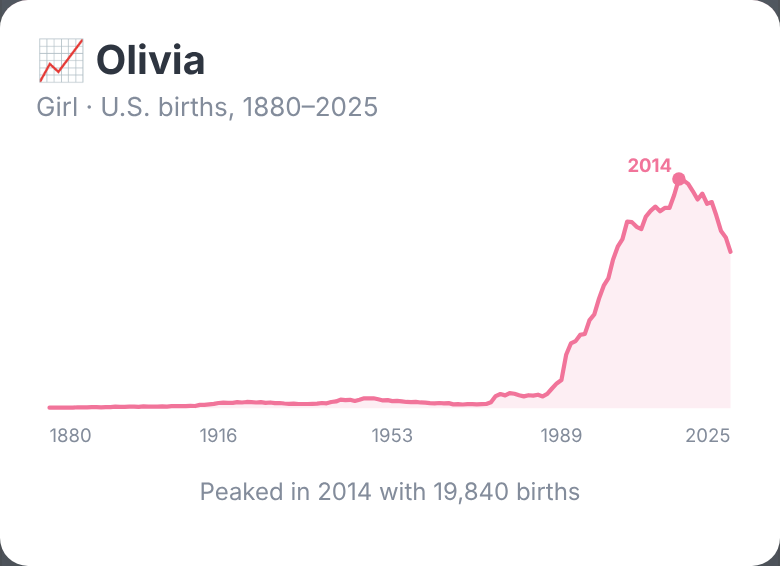
In this example, Olivia's line stays low for most of the 1900s, climbs steeply in the later decades, reaches its peak in 2014 and then eases down a little. Here's how to read each part:
- The line shows how many babies received the name in each year. Higher means more babies that year.
- The shaded area under the line is just there to make the shape easier to see.
- The dot and year mark the peak, which is the year with the most babies.
- The years along the bottom show where the chart starts and ends, with a few in between.
- The line under the chart tells you the peak year and exactly how many babies had the name that year.
The chart is meant for a quick glance, so it has no numbers down the side. Think of it as showing the shape of a name's story:
- A line that climbs and then falls shows a name that had its moment and then calmed down.
- A peak right at the end (the most recent years) means the name is at its busiest now.
- A long, nearly flat line along the bottom means the name has always been fairly uncommon.
- A steady line across many decades means a name that has stayed familiar for a long time.
One handy tip: two names can have charts that look similar but very different numbers, because each chart is scaled to fit that name's own peak. Always check the peak count under the chart to compare real size.
What the numbers can't tell you
The data counts names, not reasons. It can show you that a name climbed, but it can't tell you why, and it can't tell you what will happen next year. Think of popularity as one helpful clue when you're choosing a name, alongside how it sounds, what it means to you and how it fits with your family.
Keep exploring: See the most popular baby names of 2025, browse popular names by decade, or open Seek Baby Names and check the trend chart for a name you like.
Source: U.S. Social Security Administration national baby name data (public domain). Rankings were calculated by Seek Baby Names from those counts.